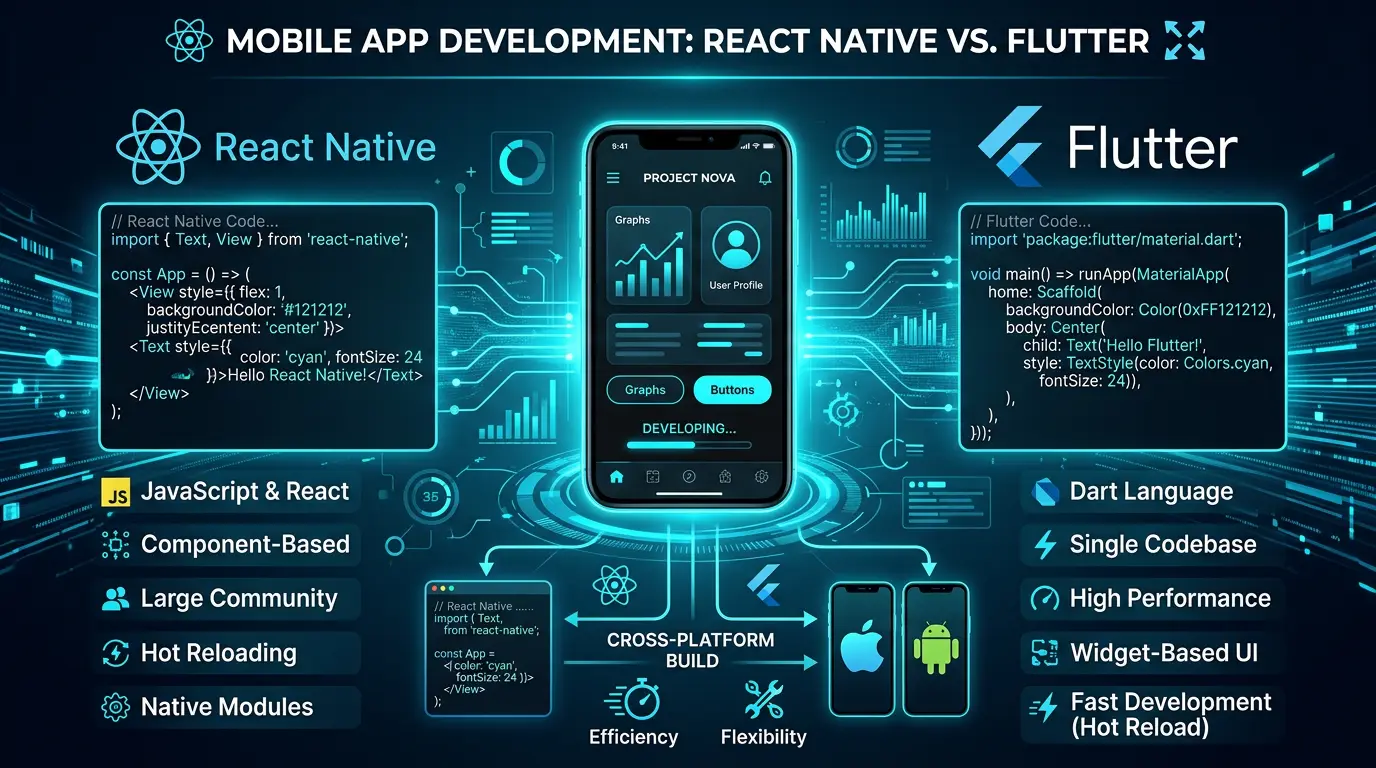
React Native vs Flutter in 2024
A comparison of cross-platform frameworks for mobile development—performance, ecosystem, and when to choose each.
Choosing between React Native and Flutter is one of the most common decisions in cross-platform mobile development. Both deliver native-like apps from a single codebase, targeting iOS and Android (and increasingly web and desktop). They've matured significantly—powering apps from Meta and Shopify (React Native) to Alibaba and BMW (Flutter). But they differ in language, architecture, performance characteristics, and ecosystem. Here's an updated comparison for 2024.
The right choice depends on your team's skills, project requirements, and long-term goals. There's no universal winner—both are production-ready and used by major companies. The key is matching the framework to your context.
React Native: JavaScript/TypeScript
React Native uses JavaScript or TypeScript and renders with native components via the bridge (or the new JSI in the React Native New Architecture). If your team already knows React, the learning curve is minimal—components, state, hooks, and the mental model transfer directly. The ecosystem is vast: npm packages, Expo for rapid prototyping and OTA updates, and a large community.
Hot reload speeds development. Performance has improved significantly with the new architecture—Fabric for the rendering layer and TurboModules for native modules reduce bridge overhead and enable synchronous native calls. Expo continues to simplify deployment and provide a managed workflow. The main tradeoff: you're still dependent on native components, which can vary in quality and consistency across platforms.
React Native's superpower is leverage. If you have a React web app, you can share logic, types, and even some components. One team, one language, multiple platforms.
Flutter: Dart
Flutter uses Dart and renders with its own engine (Skia), drawing every pixel. There's no reliance on native UI components—Flutter paints its own widgets. This yields smoother animations, pixel-perfect consistency across platforms, and the ability to create highly custom UIs without fighting platform constraints.
Flutter compiles to native ARM code, often resulting in smaller apps and faster startup than interpreted JavaScript. The widget system is expressive and compositional. Tooling is excellent: Hot Reload, DevTools for profiling, and strong IDE support. The main tradeoff: Dart is a separate language, so there's no direct code sharing with web unless you use Flutter for web (which has improved but isn't as mature as React for web).
Performance and UX
Flutter often wins on raw performance—especially for complex animations and custom UI—because it bypasses the native layer. React Native's new architecture narrows the gap, and for many apps the difference is negligible. Both can achieve 60fps; Flutter may have an edge on lower-end devices or in animation-heavy apps.
For look-and-feel: Flutter gives you complete control and consistency. React Native uses native components, so your app feels more 'native' to each platform but can have subtle differences. Choose based on whether you want a unified design language (Flutter) or platform-adaptive UI (React Native).
When to Choose
Choose React Native if you have a web team using React, need maximum package availability (npm's ecosystem), or want to share logic and types with a web app. Expo makes it especially attractive for startups and teams that want to move fast without managing native builds.
Choose Flutter if you prioritize pixel-perfect custom UI, performance on lower-end devices, or a cohesive design system across all platforms. It's also strong for apps that need complex animations or that target multiple platforms (mobile, web, desktop) from one codebase.
Decision Factors
- Team skills: React/JS experience favors React Native; new to both, Flutter's Dart is approachable
- Code sharing: React Native wins for web overlap; Flutter wins for multi-platform (mobile + desktop)
- UI requirements: Highly custom or animation-heavy? Flutter. Standard native feel? React Native
- Ecosystem: Need a specific native library? Check availability in both
- Long-term: Consider hiring—React developers are more common; Flutter developers are growing
Both frameworks are here to stay. React Native has Meta's backing and a massive ecosystem. Flutter has Google's investment and a passionate community. Evaluate your team, project, and constraints—then build. You can always migrate later if priorities change, though that's a significant undertaking. The best framework is the one your team will ship with.